 |
| Lincoln the Railsplitter (Young Woodcutter), 1964 by Norman Rockwell |
Labor Day was established in 1894 as a national tribute to American workers and their contributions to the nation’s growth and prosperity.
Today, viewed through the lens of modern economic anxiety, that tribute feels frayed. Across the country, housing costs soar, essential goods outpace wages, and working families face chaotic trade policies and threats to safety nets like Social Security and Medicare. Monopoly power consolidates, leaving small business owners squeezed and workers feeling like disposable inputs in a system built entirely for capital.
Abraham Lincoln understood that anxiety. He was not an economic theorist sitting in an ivory tower; he was a former farm hand, flatboatman, and frontier clerk who knew the physical weight of earning his bread through grueling toil.
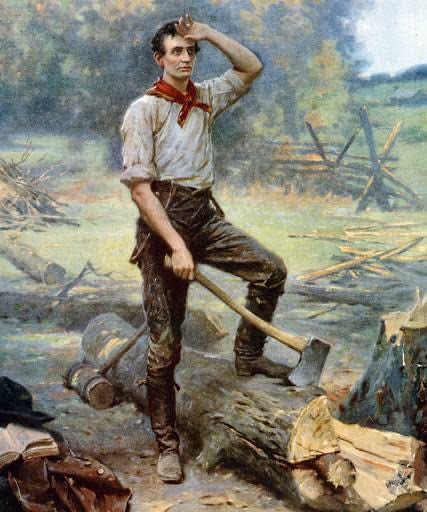
When he looked at the American economy, he saw a simple, radical truth: Human work—not capital—is the foundation of national strength.
The 1860 Shoemakers’ Strike
In March 1860, during a presidential campaign stop in Connecticut, Lincoln was asked about the massive New England shoemakers’ strike—the largest labor walkout in American history up to that point. Thousands of workers had downed tools over wage cuts.
Lincoln didn’t hedge. Rather than side with industrial owners to court campaign donors, Lincoln defended the striking workers directly:
“I am glad to see that a system of labor prevails in New England under which laborers can strike when they choose to, where they are not obliged to work under all circumstances, and are not tied down and obliged to labor whether you pay them or not!”
To Lincoln, the right to strike—the freedom to walk away from exploitation—was the defining line between a free citizen and an enslaved laborer. True economic liberty required worker leverage.
Labor Over Capital
In December 1861, in his First Annual Message to Congress, President Lincoln issued a warning against economic models that put capital ahead of human dignity:
“Labor is prior to, and independent of, capital. Capital is only the fruit of labor, and could never have existed if labor had not first existed. Labor is the superior of capital, and deserves much the higher consideration.”
Lincoln did not oppose capital or small-business enterprise. But he rejected the idea that a working person was meant to remain trapped at the bottom, serving an entrenched economic aristocracy. His philosophy was built on what he called the “Right to Rise”—a system where the “prudent, penniless beginner” could work for wages, save a surplus, buy tools or land, and eventually run an independent enterprise.
The Takeaway
Lincoln’s economic vision was not simply about employment—it was about upward mobility.
Today, as corporate profits smash records while wages stall, small owners are treated as collateral damage, and safety nets are stripped to fund corporate relief, the ladder Lincoln described has been turned upside down. A healthy economy does not measure success by the net worth of its billionaires. It measures success by whether the rungs remain within reach for the people at the bottom.
Can the people doing the work today improve their circumstances?
Can they earn enough to save?
Can they afford a home?
Can they acquire something of their own?
Can they start a business?
Can today’s workers become tomorrow’s independent owners—and eventually create jobs for others?
Labor Day is the perfect time to ask your Congressional Representative these questions, because the answers should guide your vote and support.
._____________________
Sources: Collected Works of Abraham Lincoln, vol. 4, pp. 24–25 (Speech at Hartford, March 5, 1860); vol. 5, pp. 35–53 (First Annual Message to Congress, Dec. 3, 1861).
No comments:
Post a Comment